Resources for Therapists:
Erotic & Traumatic Transference
A Brief History
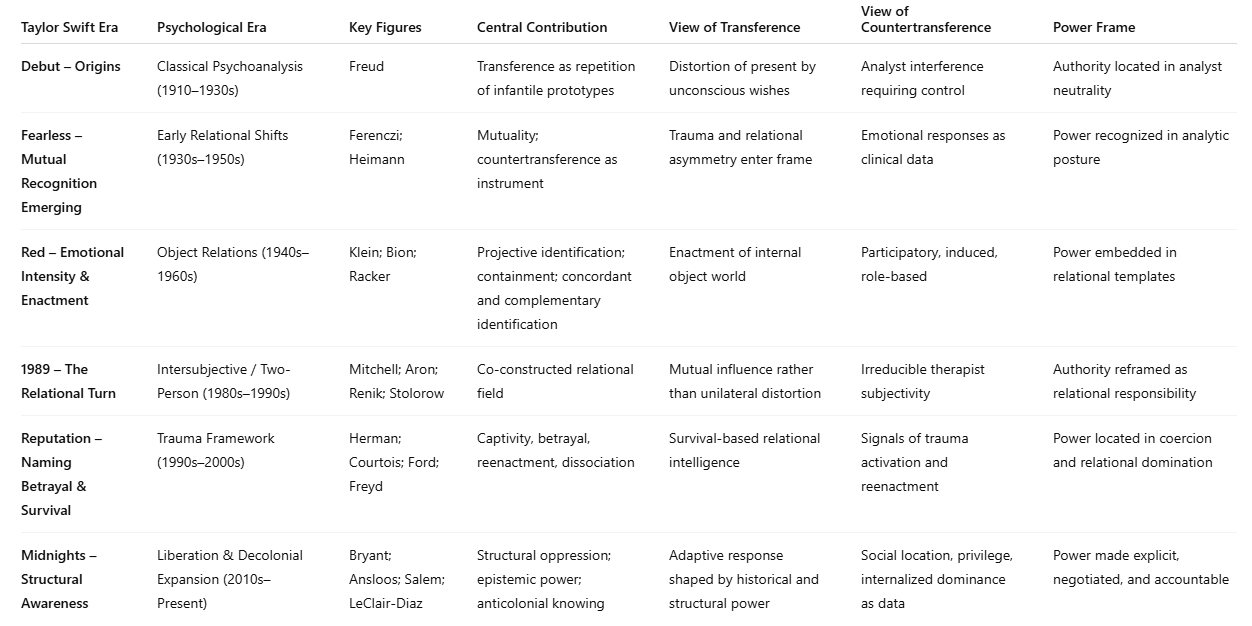
The concepts of transference and countertransference have been central to psychotherapy for more than a century, and their meaning has shifted substantially over that time. What began as a one-person model concerned with managing the analyst's distortions has become a relational, intersubjective, and increasingly liberation-informed framework for understanding how power, history, and survival enter the therapeutic field.
Freud's foundational frame. Sigmund Freud first articulated transference as a phenomenon in which feelings, expectations, and relational patterns originally associated with early caregivers were displaced onto the analyst (Freud, 1912). He observed that patients did not merely recall past relationships but relived them in the analytic encounter, often with compelling emotional immediacy. Freud framed transference initially as resistance, then as the primary medium through which unconscious material could be made conscious, working through repetition rather than suppressing it (Freud, 1914). Countertransference, in this early formulation, was treated as the analyst's unconscious interference, as a liability requiring disciplined self-analysis to prevent contamination of the treatment (Freud, 1910).
Ferenczi's mutuality. Sándor Ferenczi departed from classical orthodoxy by questioning strict neutrality and abstinence. Working with severely traumatized patients, he recognized that emotional withholding could reenact the very relational traumas patients had endured (Ferenczi, 1932). He introduced the concept of mutuality, argued for authentic responsiveness over rigid neutrality, and began to see countertransference as information rather than only interference. His attention to re-traumatization, mutual recognition, and the analyst's emotional presence opened conceptual space for later relational and trauma-informed approaches.
Heimann as instrument. Paula Heimann's 1950 paper On Countertransference marked a decisive turning point. She proposed that the analyst's emotional responses are inevitable and potentially indispensable, essential instruments for understanding the patient's unconscious communication (Heimann, 1950). Countertransference became a form of reception, providing direct access to aspects of the patient's psychic reality not yet symbolized in language.
Racker's identifications. Heinrich Racker further refined this work by distinguishing concordant from complementary countertransference (Racker, 1968). Concordant countertransference involves identification with the patient's self-experience; complementary countertransference involves identification with the patient's internalized objects. The therapist may find themselves pulled into roles corresponding to figures from the patient's relational history. This distinction remains especially clinically useful in trauma and dissociation work, where complementary pulls may evoke positions of persecutor, rescuer, or abandoning other.
Winnicott's hate and the holding environment. Donald Winnicott (1949) acknowledged that therapists may experience genuine hate toward their patients, particularly those with early environmental failures. He framed these responses not as failure but as relational data, and emphasized the therapist's capacity to survive attack as the foundation of the holding environment.
Object relations and projective identification. Melanie Klein (1946) and later Wilfred Bion (1962) reframed transference as enactment of internal object relations rather than unilateral distortion. Klein's projective identification described how disowned parts of the self are interpersonally enacted, shaping the recipient's experience. Bion's concept of containment articulated how the therapist's capacity to metabolize unbearable affect becomes central to treatment.
The intersubjective turn. Relational and intersubjective theorists moved psychoanalysis decisively from one-person to two-person psychology (Mitchell, 1988; Aron, 1996; Stolorow, Brandchaft, & Atwood, 1987). Irwin Renik (1993) argued that neutrality as traditionally conceived is neither achievable nor desirable, and that the analyst's authority lies in reflective use of subjectivity rather than detachment. Transference and countertransference came to be understood as intertwined aspects of a shared relational system.
Trauma and complex trauma frameworks. Judith Herman (1992) situated trauma within contexts of power, coercion, and silencing, reframing transference as relational intelligence shaped by survival rather than as simple repetition of infantile conflict. Christine Courtois and Julian Ford (2009) extended this work, describing how complex trauma reorganizes personality around survival in coercive systems, and how reenactment differs from enactment in carrying the weight of historical trauma.
The historical evolution moves from intrapsychic distortion to co-constructed relational field, and now toward sociopolitical accountability. Transference remains a repetition of prior relational patterns. Countertransference remains an essential source of information. Both are now situated within a living, co-created field that includes personal history, developmental attachment, structural power, and historical context. This expanded understanding does not discard earlier insights. It expands them, creating the conceptual bridge between psychoanalytic lineage and liberation-informed clinical practice.
Erotic and Traumatic Transferences
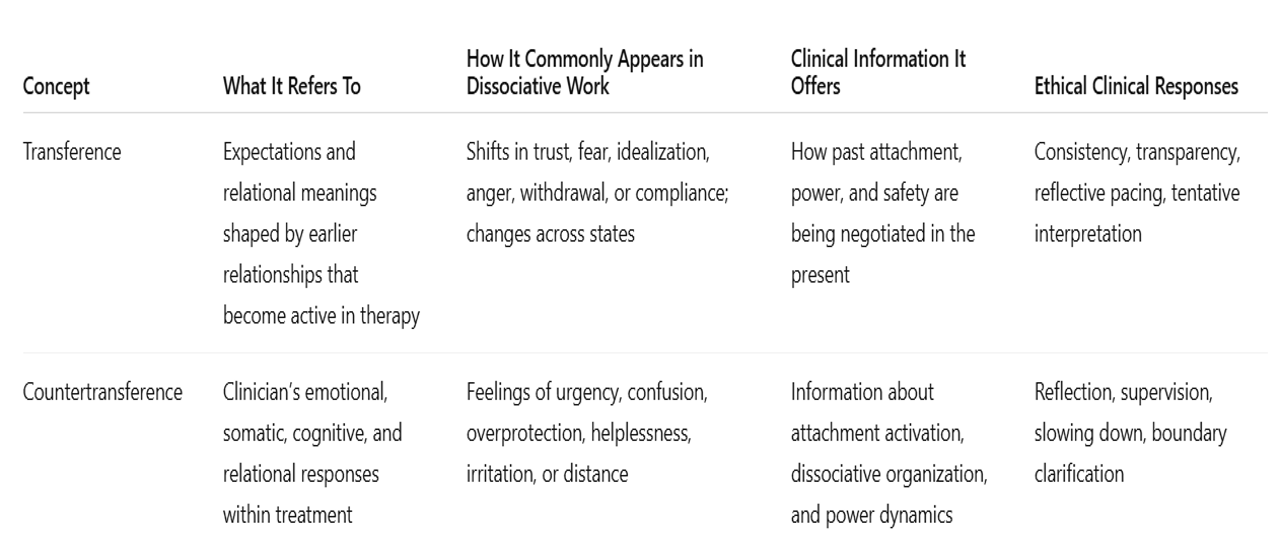
Erotic transference refers to a client developing romantic or sexual feelings toward the therapist that arise from unmet attachment needs, past relational wounds, or the intensity of the therapeutic alliance. These feelings emerge from attachment longing and relational hunger rather than from reciprocal romantic intent. The therapist is not being experienced as a person to be partnered with; the therapist is being experienced as a symbol of safety, attunement, and care that may have been unavailable earlier in life. The clinical literature generally distinguishes between erotic and eroticized transference (Blum, 1973). Erotic transference involves romantic or sexual fantasies the client recognizes as unrealistic and that do not disrupt the work. Eroticized transference is more intense, vivid, and ego-syntonic, organized around demands for love or sexual fulfillment in ways that interfere with insight and may signal earlier sexual boundary violation or trauma-based sexualization. Both forms are clinically meaningful and neither is something the client chooses or intends. The therapist's responsibility is to maintain firm, compassionate boundaries; understand the meaning of the feelings within the client's history and attachment patterns; and never enact, encourage, or reciprocate. Any sexual behavior, advance, or reciprocal sexualization by the therapist is a boundary violation and grounds for termination, referral, and reporting.
Traumatic transference refers to the reactivation of relational expectations shaped by experiences of threat, betrayal, deprivation, or coercion (Davies & Frawley, 1992; Herman, 1992). Clients with complex trauma may relate to the therapist through survival states activated by past abuse or neglect, so the present relationship becomes filtered through old survival learning. Clients may expect danger, rejection, punishment, abandonment, or control regardless of the therapist's actual behavior, and this can appear as fear, distrust, compliance, anger, testing, or withdrawal. These reactions are not distortions in a simplistic sense; they are grounded in lived relational history and reflect adaptive intelligence shaped by survival in unequal systems. The therapist's task is to remain steady, non-defensive, and boundaried to avoid reenacting past harm, recognizing that these reactions are trauma-driven rather than personal. In dissociative presentations, traumatic transference often emerges through shifts in access rather than explicit narrative — sudden withdrawal, heightened compliance, testing behaviors, or loss of voice may signal activation of earlier relational conditions, and transference may shift across self-states rather than presenting as a unitary stance toward the therapist (Davies & Frawley, 1992; West, 2013).
Where the two overlap. Erotic and traumatic transference are not always cleanly separable, particularly for survivors of childhood sexual abuse, religious trauma involving sexualized control, or coercive relationships in which care and sexualization were fused. In these cases, what presents as erotic transference may be a trauma derivative or a reenactment of conditions in which proximity, attachment, and sexualization were inseparable, or in which sexualization was the price of care. Davies and Frawley's seminal work mapped how transference and countertransference in adult survivors of childhood sexual abuse shift rapidly and kaleidoscopically across roles of victim, abuser, rescuer, and uninvolved witness, often within a single session. Recognizing this is essential because treating eroticized presentations purely as developmental erotic emergence, without attention to the traumatic template underneath, risks misreading a reenactment as an opening for interpretation. Conversely, treating all erotic material as trauma flattens the developmental and relational dimensions that may also be present.
Foundational Texts on Traumatic Transference
The seminal paper in this area, and still the one most often cited as the starting point for clinicians working with complex trauma and dissociation, is Davies and Frawley's 1992 article in Psychoanalytic Dialogues. Their book-length expansion remains a clinical staple. West's 2013 JAP paper updates that foundation through a contemporary trauma and sensorimotor lens.
Davies, J. M., & Frawley, M. G. (1994). Treating the adult survivor of childhood sexual abuse: A psychoanalytic perspective. Basic Books.
West, M. (2013). Trauma and the transference-countertransference: Working with the bad object and the wounded self. Journal of Analytical Psychology, 58(1), 73–98. https://doi.org/10.1111/j.1468-5922.2013.02018.x
Dissociation-Informed Relational Work
These are the texts most directly aligned, and Howell's work is canonical within ISSTD; Chefetz's Intensive Psychotherapy for Persistent Dissociative Processes is a clinical anchor for working inside the dissociative transference-countertransference field; Bromberg's trilogy underwrites most contemporary relational thinking on enactment and self-states.
Bromberg, P. M. (1998). Standing in the spaces: Essays on clinical process, trauma, and dissociation. Analytic Press.
Bromberg, P. M. (2006). Awakening the dreamer: Clinical journeys. Analytic Press.
Bromberg, P. M. (2011). The shadow of the tsunami and the growth of the relational mind. Routledge.
Chefetz, R. A. (2015). Intensive psychotherapy for persistent dissociative processes: The fear of feeling real. W. W. Norton.
Davies, J. M., & Frawley, M. G. (1992). Dissociative processes and transference-countertransference paradigms in the psychoanalytically oriented treatment of adult survivors of childhood sexual abuse. Psychoanalytic Dialogues, 2(1), 5–36. https://doi.org/10.1080/10481889209538920
Howell, E. F. (2011). Understanding and treating dissociative identity disorder: A relational approach. Routledge.
Howell, E. F. (2020). Trauma and dissociation informed psychotherapy: Relational healing and the therapeutic connection. W. W. Norton.
Howell, E. F., & Itzkowitz, S. (Eds.). (2016). The dissociative mind in psychoanalysis: Understanding and working with trauma. Routledge.
Pearlman, L. A., & Saakvitne, K. W. (1995). Trauma and the therapist: Countertransference and vicarious traumatization in psychotherapy with incest survivors. W. W. Norton.
Foundational Texts on Erotic Transference
Mann's two books are the most accessible and comprehensive entry points for clinicians who want a theoretically grounded but practical framework. Maroda's work is essential for anyone working with affect, self-disclosure, and the place where erotic and traumatic material braid together. Blum's classic paper introduced the distinction between erotic and eroticized transference that still organizes much of the clinical literature.
Blum, H. P. (1973). The concept of erotized transference. Journal of the American Psychoanalytic Association, 21(1), 61–76. https://doi.org/10.1177/000306517302100104
Celenza, A. (2007). Sexual boundary violations: Therapeutic, supervisory, and academic contexts. Jason Aronson.
Celenza, A. (2014). Erotic revelations: Clinical applications and perverse scenarios. Routledge.
Mann, D. (1997). Psychotherapy: An erotic relationship: Transference and countertransference passions. Routledge.
Mann, D. (Ed.). (1999). Erotic transference and countertransference: Clinical practice in psychotherapy. Routledge.
Maroda, K. J. (1991). The power of countertransference: Innovations in analytic technique. Wiley.
Maroda, K. J. (1999). Seduction, surrender, and transformation: Emotional engagement in the analytic process. Analytic Press.
Where Erotic and Traumatic Transference Intersect
This is the territory most relevant to the population of survivors of childhood sexual abuse, religious trauma, and coercive control… these frequently bring eroticized transference that is itself a trauma derivative rather than a developmental erotic emergence. Gabbard's work on boundary violations belongs here for both clinical and ethics training purposes.
Gabbard, G. O. (1996). Love and hate in the analytic setting. Jason Aronson.
Gabbard, G. O., & Lester, E. P. (1995). Boundaries and boundary violations in psychoanalysis. Basic Books.
Lans, O., Gewirtz-Meydan, A., & Reuveni, L. (2024). Addressing the elephant in the room: How erotic transference is identified and understood in therapy. British Journal of Guidance & Counselling, 53(5), 690–702. https://doi.org/10.1080/03069885.2024.2373187
Wrye, H. K., & Welles, J. K. (1994). The narration of desire: Erotic transferences and countertransferences. Analytic Press.
Open-Access Articles Worth Sharing with Supervisees
Ladson, D., & Welton, R. (2007). Recognizing and managing erotic and eroticized transferences. Psychiatry (Edgmont), 4(4), 47–50. https://pmc.ncbi.nlm.nih.gov/articles/PMC2921238/
A review of Mann's Psychotherapy: An Erotic Relationship is also openly available and serves as a fast orientation to the framework: https://pmc.ncbi.nlm.nih.gov/articles/PMC3330517/
Related Historical and
Liberation-Framework References
Ainsworth, M. D. S., Blehar, M. C., Waters, E., & Wall, S. (1978). Patterns of attachment: A psychological study of the strange situation. Lawrence Erlbaum.
Ansloos, Jeffrey; Beaulne-Stuebing, Rebecca (2024-05-03). "Wounds on This Turtle's Back: On Feeling Extractivism and Felt Theories of Change". Environmental Justice. doi:10.1089/env.2023.0055. ISSN 1939-4071.
Aron, L. (1996). A meeting of minds: Mutuality in psychoanalysis. Analytic Press.
Bion, W. R. (1962). Learning from experience. Heinemann.
Bowlby, J. (1969). Attachment and loss: Vol. 1. Attachment. Basic Books.
Bromberg, P. M. (1998). Standing in the spaces: Essays on clinical process, trauma, and dissociation. Analytic Press.
Brown, L. S. (1991). Not outside the range: One feminist perspective on psychic trauma. Psychoanalysis and Contemporary Thought, 14(1), 119–133.
Brown, L. S. (2018). Not the price of admission: Healthy relationships after childhood trauma. Rowman & Littlefield.
Bryant, T. (2024). Lessons from decolonial and liberation psychologies for the field of trauma psychology. American Psychologist, 79(5), 683–696. https://doi.org/10.1037/amp0001393
Courtois, C. A., & Ford, J. D. (2009). Treating complex traumatic stress disorders: An evidence-based guide. Guilford Press.
Courtois, C. A., & Ford, J. D. (2013). Treatment of complex trauma: A sequenced, relationship-based approach. Guilford Press.
Danylchuk, B., & Connors, M. (2024). Treating complex trauma and dissociation: A practical guide for therapists (2nd ed.). Routledge.
Deeg-Davis, M. (2024). Exploring the Lived Experiences of Women Trauma Counselors: Two Interpretative Phenomenological Analysis Studies Making Meaning of Specialization and Resilience. : Oregon State University.
Dorahy, M. J., Brand, B. L., Şar, V., Krüger, C., Stavropoulos, P., Martínez-Taboas, A., Lewis-Fernández, R., & Middleton, W. (2014). Dissociative identity disorder: An empirical overview. Australian & New Zealand Journal of Psychiatry, 48(5), 402–417. https://doi.org/10.1177/0004867414527523
Dorahy, M. J., Corry, M., Shannon, M., Webb, K., McDermott, B., Ryan, M., & Dyer, K. F. W. (2013). Complex trauma and intimate relationships: The impact of shame, guilt and dissociation. Journal of Affective Disorders, 147(1–3), 72–79. https://doi.org/10.1016/j.jad.2012.10.010
Ferenczi, S. (1932). The clinical diary of Sándor Ferenczi. Harvard University Press.
Freud, S. (1910). The future prospects of psycho-analytic therapy. In J. Strachey (Ed. & Trans.), The standard edition of the complete psychological works of Sigmund Freud (Vol. 11, pp. 139–151). Hogarth Press.
Freud, S. (1912). The dynamics of transference. In J. Strachey (Ed. & Trans.), The standard edition of the complete psychological works of Sigmund Freud (Vol. 12, pp. 97–108). Hogarth Press.
Freud, S. (1914). Remembering, repeating and working-through. In J. Strachey (Ed. & Trans.), The standard edition of the complete psychological works of Sigmund Freud (Vol. 12, pp. 145–156). Hogarth Press.
Freyd, J. J. (1996). Betrayal trauma: The logic of forgetting childhood abuse. Harvard University Press.
Gómez, J. M. (2019). Group dynamics as a predictor of dissociation for Black victims of violence: An exploratory study of cultural betrayal trauma theory. Transcultural Psychiatry, 56(5), 878–894. https://doi.org/10.1177/1363461519847300
Gómez, J. M., Smith, C. P., Gobin, R. L., Tang, S. S., & Freyd, J. J. (2016). Collusion, torture, and inequality: Understanding the actions of the American Psychological Association as institutional betrayal. Journal of Trauma & Dissociation, 17(5), 527–544. https://doi.org/10.1080/15299732.2016.1214436
Hayes, J. A., Gelso, C. J., & Hummel, A. M. (2011). Managing countertransference. Psychotherapy, 48(1), 88–97. https://doi.org/10.1037/a0022182
Heimann, P. (1950). On counter-transference. International Journal of Psychoanalysis, 31, 81–84.
Herman, J. L. (1992). Trauma and recovery. Basic Books.
Hook, J. N., Davis, D. E., Owen, J., Worthington, E. L., Jr., & Utsey, S. O. (2013). Cultural humility: Measuring openness to culturally diverse clients. Journal of Counseling Psychology, 60(3), 353–366. https://doi.org/10.1037/a0032595
Klein, M. (1946). Notes on some schizoid mechanisms. International Journal of Psychoanalysis, 27, 99–110.
Kluft, R. P. (1993). Basic principles in conducting the psychotherapy of multiple personality disorder. Dissociation, 6(2–3), 93–105.
Lanius, R. A. (2015). Trauma-related dissociation and altered states of consciousness: A call for clinical, treatment, and neuroscience research. European Journal of Psychotraumatology, 6, 27905. https://doi.org/10.3402/ejpt.v6.27905
Lanius, R. A., Frewen, P. A., Tursich, M., Jetly, R., & McKinnon, M. C. (2015). Restoring large-scale brain networks in PTSD and related disorders: A proposal for neuroscientifically-informed treatment interventions. European Journal of Psychotraumatology, 6, 27313. https://doi.org/10.3402/ejpt.v6.27313
LeClair-Diaz, Amanda (2024-05-08). ""Why Don't We Try Something New?": How Indigenous Educators Supported One Another in Leaning Toward in Community-Based Inquiry". American Indian Culture and Research Journal. 47 (1). doi:10.17953/A3.1613. ISSN 0161-6463.
Lyons-Ruth, K. (2003). Dissociation and the parent–infant dialogue: A longitudinal perspective from attachment research. Journal of the American Psychoanalytic Association, 51(3), 883–911. https://doi.org/10.1177/00030651030510031501
Lyons-Ruth, K., & Jacobvitz, D. (2008). Attachment disorganization. In J. Cassidy & P. R. Shaver (Eds.), Handbook of attachment: Theory, research, and clinical applications (2nd ed., pp. 666–697). Guilford Press.
Main, M., & Hesse, E. (1990). Parents’ unresolved traumatic experiences are related to infant disorganized attachment status: Is frightened and/or frightening parental behavior the linking mechanism? In M. T. Greenberg, D. Cicchetti, & E. M. Cummings (Eds.), Attachment in the preschool years: Theory, research, and intervention (pp. 161–182). University of Chicago Press.
Markin, R. D., Kivlighan, M., Pérez-Rojas, A. E., & Phelps, R. (2023). Introduction to special section: Addressing racism, anti-blackness, and racial trauma in psychotherapy. Psychotherapy, 60(1), 24–26. https://doi.org/10.1037/pst0000470
Mehra, L. M., Kallen, A. M., Potter, M., Udupa, N. S., Bryen, C. P., Kemper, T. S., Sachs-Ericsson, N. J., & Joiner, T. E. (2026). Therapist cultural humility in early psychotherapy: A catalyst for improved client functioning at treatment termination. Psychotherapy Research, 36(2), 287–307. https://doi.org/10.1080/10503307.2025.2481268
Mitchell, S. A. (1988). Relational concepts in psychoanalysis: An integration. Harvard University Press.
Racker, H. (1968). Transference and countertransference. International Universities Press.
Renik, O. (1993). Analytic interaction: Conceptualizing technique in light of the analyst’s irreducible subjectivity. The Psychoanalytic Quarterly, 62(4), 553–571.
Salem, S. (2023). Exploring Anticolonialism Through Intimate Forms Of knowing. Raisons politiques, 89(1), 61-76. https://doi.org/10.3917/rai.23.0061.
Smith, C. P., & Freyd, J. J. (2014). Institutional betrayal. American Psychologist, 69(6), 575–587. https://doi.org/10.1037/a0037564
Steele, K., Boon, S., & van der Hart, O. (2017). Treating trauma-related dissociation: A practical, integrative approach. W. W. Norton & Company.
Stolorow, R. D., Brandchaft, B., & Atwood, G. E. (1987). Psychoanalytic treatment: An intersubjective approach. Analytic Press.
Sunshaw, E. (Host). (2025). Interview with Chuck Benincasa. In System Speak. Podcast.
Sunshaw, E. (Host). (2025). Interview with Thema Bryant. In System Speak. Podcast.
van der Hart, O., Nijenhuis, E. R. S., & Steele, K. (2006). The haunted self: Structural dissociation and the treatment of chronic traumatization. W. W. Norton & Company.
Winnicott, D. W. (1949). Hate in the counter-transference. International Journal of Psychoanalysis, 30, 69–74.