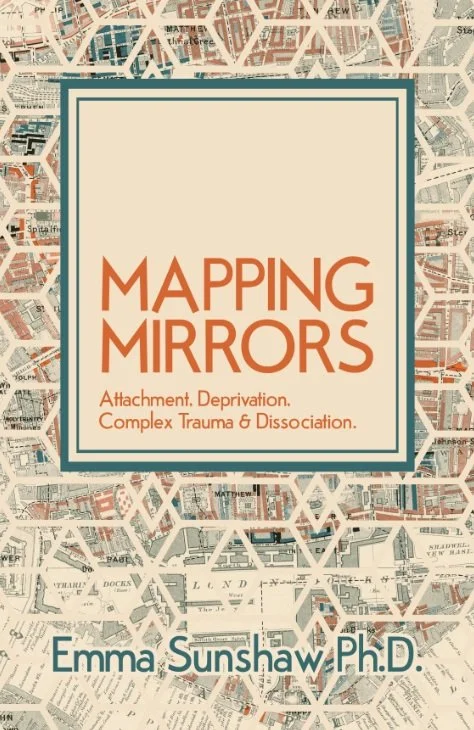
Mapping Mirrors offers a deeply relational understanding of trauma, dissociation, and healing. Drawing on attachment theory, neurobiology, psychoanalytic traditions, liberation psychology, and lived experience, the book traces how identity forms through reflection long before language. It follows how deprivation, misattunement, and betrayal shape the organization of selfhood over time and in relationship. It explores how deprivation, misattunement, and betrayal shape the organization of selfhood across development and relationship.
Dissociation is approached as an intelligent developmental response to conditions that could not reliably sustain a single, unified self. Through the concepts of mirror states, internal social contracts, and multiplicity, Mapping Mirrors shows how dissociative systems preserve attachment, meaning, and continuity under relational threat. These systems are understood as organized, responsive, and historically grounded, carrying the imprint of survival rather than defect.
Healing unfolds through dignity, inclusion, and relational repair. The book introduces synthesis as a developmental process that allows distinct self-states to communicate, influence one another, and grow without erasure. Emergent selves arise as safety increases and recognition becomes possible, supporting movement toward shared life rather than enforced sameness.
Written for clinicians, survivors, and those working at the intersection of trauma and care, Mapping Mirrors offers a compassionate, rigorously grounded framework for understanding dissociation as meaningful organization and for supporting healing as an ongoing process of becoming. The work centers trustworthy mirrors in therapy, community, culture, and relationship, making room for belonging, voice, and delight in being.
CLICK HERE TO ORDER

Memoir:
Lived Experience Dissociation Workbook:

The Problems of
(Complex Trauma)
Therapy

Ethical, Historical, & Cultural Issues
